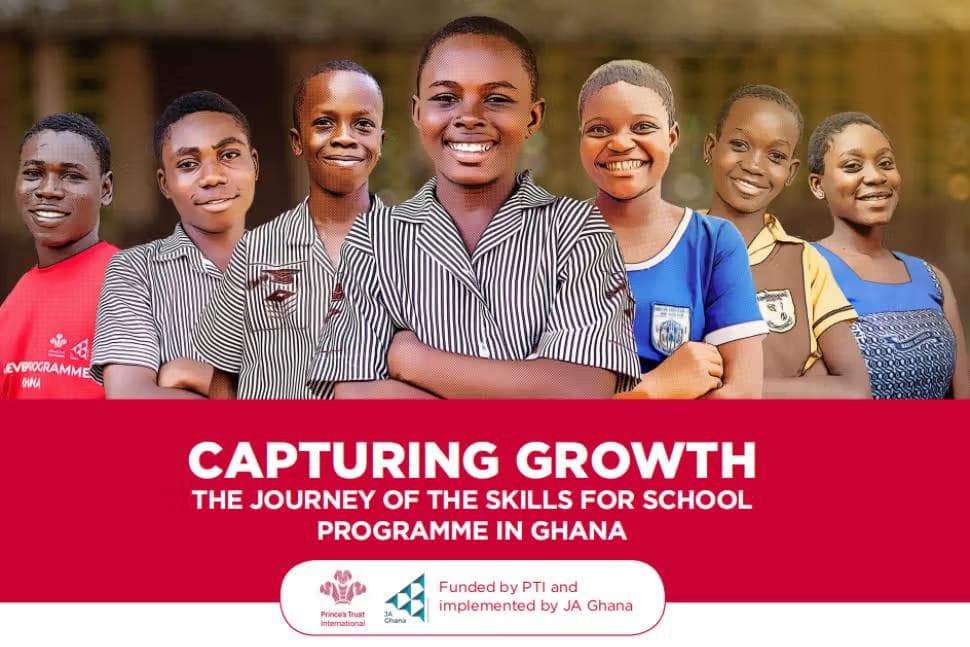
The Achieve Programme
An early intervention personal development and employability program that helps students develop essential soft skills and prepare for success beyond school.
About This Program
THE ACHIEVE SKILLS FOR SCHOOL PROGRAMME
The Achieve Skills for School Programme(S4S) is a personal development intervention designed to help underachieving or disengaged students in Ghana build essential core skills for academic and life success. Developed by the King’s Trust UK, it is delivered and supported by the King’s Trust International in partnership with Junior Achievement (JA) Ghana. S4S engages students through interactive, club-based activities focused on communication, managing feelings, confidence, reliability, teamwork, and goal-setting.
Table 1: Theory of change for S4S
Context and Need
Many Ghanaian youth (11–19) face poor attendance, low engagement, weak interpersonal skills, and low confidence. The lack of a nurturing environment to build self-esteem and develop essential core skills hinders educational progress and long-term potential.
Who We Support
Learners aged 11–19 in basic schools showing signs of disengagement or poor social functioning.
What We Provide
A 15-week tailored curriculum, trained facilitators, small groups, safe spaces, culturally relevant content, practical resources, and strong monitoring tools.
What We Do
Weekly sessions on core skills, peer learning, and learner-centered activities.
Short-term Change
Improved class engagement, improved confidence, teamwork, emotional regulation, and reduced negative behaviors.
Impact and Long-term Change
Medium term: improved academics and self-management skills.
Long term: higher attainment, smooth transitions to further education or jobs, and meaningful contributions to society.
COMPARATIVE IMPACT ASSESSMENT
Since launching in 2020, Skills for School has expanded from 5 to 42 schools, supporting over 5,000 young people.
To measure its true impact, a comparative impact assessment was conducted in four participating schools, involving 202 students split into participant and control groups. Students from both groups completed skills self-assessment surveys before the programme began and again 15 weeks later, after it had concluded in their school.
The results were a striking endorsement of the programme’s impact. Participants showed significant improvements across all six skill areas, most notably in teamwork and managing feelings, with average scores for both up 35%. Meanwhile, students outside the programme saw skills improvements of just 1.5% to 3.9% in four areas, while their skills in managing feelings and setting goals actually declined slightly in the second survey.
CASE STUDIES
From Shadows to Spotlight: Iris
When Iris first heard about the Achieve Skills for School programme, she saw reflections of her own struggles in the stories of her peers. Encouraged by her teacher, she joined with hope of the personal transformation ahead.
Struggling with low confidence, poor grades, and a strained relationship with her parents, she once considered dropping out of school.
Through the programme, Iris discovered her strengths, built confidence, and developed a positive mindset. “Now, I come to school with happiness and confidence,” she says. Her proudest moment was solving a math problem in front of her class, earning respect from peers who once doubted her.
Her teacher, Clement, notes:
“…after going through the Achieve Skills for School programme, her transformation is remarkable. Out of curiosity, I decided to discreetly visit her class and ask her classmates how they perceived her now. The feedback was overwhelmingly positive, with her peers expressing appreciation for the changes they had noticed in her. Academically, she was an average student. But now, she is doing well. I teach the science subject, so with my area, she is improving.”
Iris’ story shows how the Achieve Skills for School programme empowers students to believe in themselves and build brighter futures.
From hurting others to helping others: Philemon
Philemon, a 14-year-old student, joined the Achieve Skills for School Programme after hearing about its positive impact from friends. Before joining, he admits, “I liked bullying people even during school gathering… We would bring our food and money, and we would show it off, saying, ‘See what we have; it is better than yours,’ and then start laughing, using abusive words wherever we saw them.”
The programme’s Communication and Managing Feelings sessions, particularly on bullying, helped him see the harm in his actions. “Communication has helped me speak politely with my friends and adults…Managing feelings has also helped me stop bullying and control my facial expressions…I do not use abusive language or gather friends to tease others anymore.”
His peers noticed the change. “He doesn’t mock me anymore,” said Alfred. Bright added, “We can now work together. He is cooler now.”
Today, Philemon encourages kindness:
“Even if your friends provoke you, do not respond with harsh actions. Always speak politely.”
Philemon’s story shows how the Achieve Skills for School programme helps students grow into kind and confident individuals.
To find out more, visit; https://jaghana.org/programs/the-achieve-skills-for-schools-programme-in-ghana/
Key Outcomes
Program Details
Target Group
Ages 11-19
Duration
17 weeks
Focus Area
Work Readiness